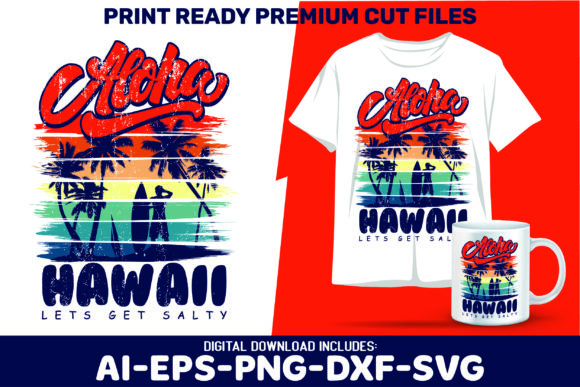
Aloha Hawaii Let's Get Salty SVG: A Designer's Review
As a designer who spends more time staring at stitch maps than most people stare at their phones, I approach every new digital embroidery file with a healthy dose of skepticism. We have all been there: you buy a cute graphic, load it into your software, and realize the underlay is non-existent or the lettering is too thin to survive a single wash. That is why I took a close look at the Aloha Hawaii Let s Get Salty SVG PNG before committing it to any client projects. This isn't just about whether it looks good on a screen; it is about whether it holds up as a machine embroidery design on actual fabric.
My first impression of this asset was its mood. It captures that specific vintage beach vibe that is currently dominating the Crafts and Graphics markets. The typography feels relaxed but legible, and the layout suggests a design meant for summer apparel. However, seeing it as a sublimation design originally, my immediate thought as an embroiderer was, "How will this translate to thread?" The phrase "Let's Get Salty" paired with tropical elements creates a playful, slightly edgy personality that fits perfectly with the current trend of ironic vacation wear. It feels less like a generic tourist souvenir and more like something a boutique brand would put on a limited-run collection.
Real-World Application: The Tote Bag Test
To truly evaluate this design, I imagined a specific real-life scenario. Picture a custom order for a local beach shop needing a run of branded tote bag designs. They want something durable, washable, and visually striking. The Aloha Hawaii Let s Get Salty SVG PNG immediately came to mind as a candidate. Because the description highlights that it is a 100 Vector Editable file, I know I have the flexibility to manipulate the paths before converting them into stitches. This is crucial. In a real embroidery project, you rarely use a file exactly as downloaded. You need to adjust sizing, perhaps simplify complex gradients for thread limitations, and ensure the flow works with the nap of the fabric.
If I were stitching this onto a canvas tote, the bold lettering would likely require a robust fill stitch to ensure coverage without gaps. The vintage aesthetic suggests using slightly muted thread colors rather than neon brights, which would clash with the intended retro feel. For a sweatshirt embroidery project, the texture of the fleece would demand even higher stitch density to prevent the fabric from peeking through the letters. The design's layout seems balanced enough to sit comfortably on a chest pocket or centered on a back panel without looking cramped.
Navigating Fabric and Hoop Constraints
While the visual appeal is strong, practical application requires caution. Not every surface is friendly to this type of graphic. If you are planning to use this on a curved surface like a cap, you must be wary of the distortion. The text "Let's Get Salty" needs to remain horizontal and readable; warping it over a structured front panel could make it look amateurish unless you have significant experience with cap framing. Similarly, on stretchy fabrics like jersey knits used for baby embroidery, the stability of the design is paramount. Without a high-quality cut-away stabilizer, the dense areas of the text could cause the fabric to pucker over time.
Another consideration is the size of your hoop. While the vector nature means it can be scaled infinitely on a computer, your machine has physical limits. If you are working with a small 4x4 hoop, you might need to split the design or reduce the size significantly, which brings us to the issue of detail. Tiny decorative elements in the original graphic might vanish if scaled down too far. Always check the smallest details against your needle size. A running stitch that looks crisp at 10 inches might break or look jagged at 2 inches.
Commercial Viability for Etsy Sellers
For Etsy sellers and small shop owners, the value of a design lies in its versatility and the professionalism of the finished product. This design hits a sweet spot for commercial embroidery because it taps into evergreen themes: summer, travel, and humor. It works well for personalized gifts, such as adding a family name above the graphic on a beach towel, or creating matching sets for a bachelorette party heading to Hawaii. The ability to change colors (as noted in the product features) allows you to offer customization options without needing multiple files. You can easily swap a classic navy thread for a coral pink to match a customer's specific brand palette.
However, before listing this as a small shop product, you must verify the licensing terms. The description mentions it is exclusively available and includes AI and EPS formats, which is great for editing, but it does not explicitly state the commercial license limits for the embroidered output. As a professional, I always advise checking whether the license covers physical goods sold at craft fairs versus digital resale. Never assume; always read the fine print to protect your craft business.
Technical Notes for the Stitch-Out
Before running this on a final garment, here are my practical recommendations for ensuring a high-quality result:
- Test on Scrap Fabric: Always stitch a sample on the exact same material you plan to use for the final item. Thread tension behaves differently on linen than on polyester.
- Check Contrast: Ensure your thread colors contrast sufficiently with the fabric. A light beige thread on a cream tote bag will render the "Salty" message invisible.
- Review Stitch Density: Since this started as a sublimation design, you may need to manually adjust the density when converting to an embroidery file. Too dense, and the fabric becomes stiff; too sparse, and the backing shows.
- Mockup Verification: Create black and white mockups to check the silhouette. If the design loses its shape without color, it might rely too heavily on color blocking rather than form.
- Stabilizer Selection: For textured fabrics, use a water-soluble topper to prevent stitches from sinking into the pile, especially for the smaller text elements.
In conclusion, the Aloha Hawaii Let s Get Salty SVG PNG offers a solid foundation for creative entrepreneurs looking to expand their summer collections. Its vector editability is a significant plus, allowing for necessary tweaks to suit various hoop sizes and fabric types. While it requires a thoughtful approach to digitizing and stabilizing to ensure longevity, the end result can be a charming, high-value addition to any handmade product line. Whether you are making a single embroidered patch for a friend or a hundred shirts for a boutique, this design has the potential to perform well if treated with the technical respect it deserves.